This is the first in a series explaining Amendment 3 – it is not advocating for or against the Amendment – just explaining the various components in the Amendment and what they would mean for St. Johns County.
Let’s dive in.
During Florida’s 2026 regular legislative session, lawmakers considered seven different proposals to reduce or eliminate portions of property taxes. None reached the ballot during the regular session.
On May 27, Governor Ron DeSantis announced a new “Save Our Homes” proposal and called the Legislature into a special session. The proposed constitutional amendment was filed June 1, revised during the legislative process and approved by both chambers June 2.
The original proposal applied the expanded exemption to school taxes as well as non-school taxes and created a path for the exemption eventually to reach a home’s full assessed value. During the Senate committee process, lawmakers removed school district taxes from the expanded exemption. The final ballot version applies the new $150,000 and $250,000 exemptions only to non-school property taxes. School taxes would remain subject to the existing $25,000 homestead exemption.
The final version of the Amendment does NOT match the savings calculator published on the Save our Homes website Save Our Homes FL
This is important. You and I may have been some of the many residents who went to that website to see what our savings would be. And it generates a higher number than we would see under the final version of Amendment 3
Why?
The State of Florida’s Save Our Homes calculator does not calculate savings solely under the final version of Amendment 3. Its own disclaimer says that it estimates what homeowners would have saved if the broader Save Our Homes proposal had applied to their 2025 tax bills. Because the original proposal included school taxes and the final amendment does not, the calculator may show greater savings than a homeowner would receive under the version appearing on the ballot.
What’s in the Amendment
For many voters, the first numbers they see may be the only ones they remember: a $150,000 exemption in 2027 and a $250,000 exemption in 2028. Who wouldn’t want a larger property tax exemption?
But those numbers are only the beginning of Amendment 3. The proposal also changes how local tax dollars may be used, gives the Legislature a much larger role in defining local government responsibilities, and creates a process for potentially expanding the exemption even further. Those provisions may be less eye-catching, but their long-term effects could be much more significant.
That is why this series will examine Amendment 3 in smaller pieces: what it would do to an individual tax bill, what it could mean for county services and nonprofit organizations, and how it would shift authority over local budgets from local elected officials to Tallahassee.
Here’s the language of the Amendment that will appear on your ballot:
INCREASED HOMESTEAD EXEMPTION; LOWER CAP ON INCREASES IN NONHOMESTEAD PROPERTY ASSESSMENTS
This amendment increases the homestead exemption, for all non-school taxes, to $150,000 in 2027 and $250,000 in 2028, and adjusts for inflation thereafter. It requires the Legislature to prescribe a uniform procedure for counties and municipalities, for their respective levies, to increase the homestead exemption up to full assessed value, and allows special districts, subject to referendum approval, to do the same. Persons who are not Florida residents on December 31, 2026, will receive the existing homestead exemption upon qualifying for a homestead exemption, with the increased homestead exemption beginning with the fifth year of exemption, to the extent permitted by the U.S. Constitution.
This amendment reduces the annual cap on assessment increases for non-homestead properties from 10% to 5%. This amendment requires counties and municipalities to use property taxes solely for public safety, education and schools, infrastructure, natural resources, bond debt service, retirement benefits for employees, and operations and administration. Other expenditures may be approved by county officers or county or municipal governing bodies unless prohibited by general law, notwithstanding Article VII, Section 9(a) of the Florida Constitution, which allows counties and municipalities to levy property taxes for their respective purposes. This amendment takes effect January 1, 2027.
St. Johns County has created a webpage explaining the proposed Property Tax Amendment 3 that will appear on Florida’s November 3 ballot. Check that out here: St. Johns County Amendment 3 Info
They held a Town Hall on Tuesday, September 29. If you missed it, check out the video here: SJC Town Hall – Amendment 3
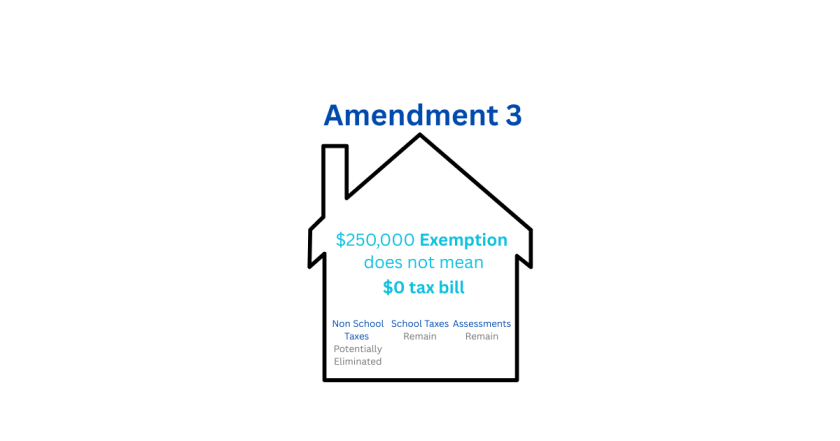
One of the easiest misunderstandings is that a home assessed below $250,000 would no longer have a property tax bill if the amendment passes.
That is not correct.
What the Amendment Would Change
If approved by at least 60% of voters statewide, Amendment 3 would increase the homestead exemption applied to non-school property taxes:
Up to $150,000 beginning January 1, 2027
Up to $250,000 beginning January 1, 2028
Annual inflation adjustments beginning in 2029
The expanded exemption would not apply to school district property taxes. The standard homestead exemption for school taxes would remain $25,000.
The amendment would also reduce the annual assessment increase allowed on most non-homestead property from 10% to 5%. It would require people establishing Florida residency on or after January 1, 2027, to wait until their 5th year of residency before receiving the expanded homestead exemption.
What a $200,000 Property Bill Could Look Like
Consider a hypothetical homesteaded property with an assessed value of $200,000. After the $250,000 non-school exemption is fully implemented, that property could have no remaining taxable value for the affected non-school taxes.
But $175,000 would still be subject to school taxes after the standard $25,000 school exemption. Using 2025 St. Johns County millage rates only as an illustration, the school taxes would be approximately $1,098.
Non-ad valorem assessments would also remain. These are charges placed on the tax bill but not calculated from taxable value. They may include solid-waste charges, community development district assessments and other property-specific assessments.
Using actual charges from one St. Johns County tax bill as an illustration, the remaining non-ad valorem assessments include solid-waste disposal, collection and recycling charges, along with a CDD assessment.
Illustrative 2028 Bill on a $200,000 Assessed Value
Amount
Non-school property taxes
$0
School property taxes
$1,098
Illustrative solid-waste assessments
$334
Total without a CDD assessment
$1,432
Illustrative CDD assessment, if applicable
$1,486
Total with the illustrative CDD assessment
$2,918
The CDD amount would vary by CDD entity, and many properties in the county have no CDD assessment. The point is that even when the affected non-school property tax falls to zero, the total bill does not.
“The first $250,000 is exempt” means exempt from certain non-school property taxes. It does not mean a zero-property tax bill.
In the next article, we will look at who receives the tax benefit and who does not.
If you are finding value in these updates, please subscribe to my blog so you get notifications when I publish an update. Feel free to share with others who may find value in the content.
Keeping the focus on the important Ag Enclave activities in St. Johns County, let’s catch up with what has happened in September.
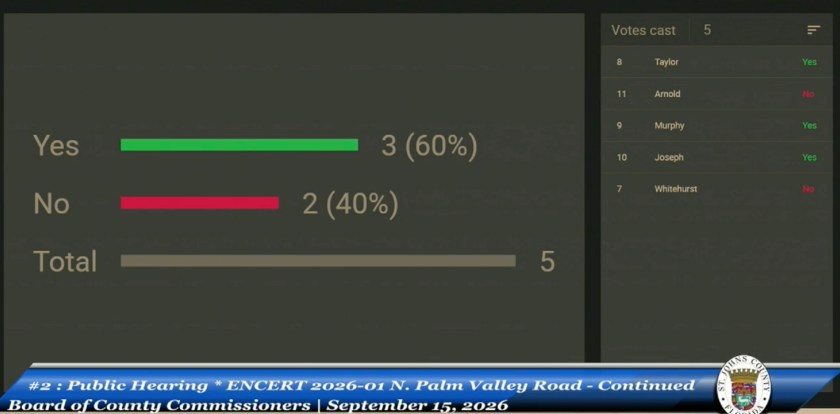
On September 15, the BOCC formally denied certification of the 4,462-acre N. Palm Valley Agricultural enclave by a 3-2 vote, with Whitehurst and Arnold casting the no votes. Just a few moments later they approved the 310-acre AFI Enclave, also by a 3-2 vote, with Taylor and Joseph casting the no votes.
What was important in that meeting was that with the denial of the N. Palm Valley Enclave, the county has the test case for the courts to decide if a local government can deny an application that county staff has determined meets the criteria for the Agricultural Enclave certification.
What was evident in discussion during the meeting was the chosen strategy – litigate in St. Johns County rather than Leon County. County Attorney Rich Komando relayed outside counsel’s recommendation that the best path was to deny the application, creating the opportunity for the applicant to challenge that denial.
This creates an interesting scenario. The Commissioners deliberately chose to deny the application in order to create the court challenge. Commissioner Murphy had stated previously there was “no legal reason to deny” the application. Now, he has reversed course and the implication from the dais was that the denial was done specifically to enable the county to challenge SB 686 in the courts.
There were a few public comments that challenging the law in court would allow insurance to cover the cost of the litigation. It will be interesting to see if the county’s insurance does cover litigation in a case that was intentionally created by the Commissioners to challenge this law. It is on record, in multiple meetings, that is the intent of the denial.
There were a few points in the meeting that you may want to hear for yourself how the discussion went. The first was in Public Comment when Commissioner Whitehurst encouraged anyone there to speak on the N. Palm Valley Enclave agenda item to speak up during General Public Comment. He was seeking clarification that the public comment portion for that agenda item was closed and the Commission was just continuing deliberations on Tuesday.
The stated criterion for denial presents an interesting question for the courts. And it could indeed set a precedent for Agricultural Enclaves across the state. The statute requires portions of an agricultural enclave perimeter to be surrounded by land designated and developed for industrial, commercial or residential purposes. The question being raised is, what qualifies as “existing industrial, commercial or residential development.”
The applicant’s argument is that surrounding properties in Nocatee and Roscoe Boulevard have been platted and therefore meet the statutory definition of development. The applicant’s attorney pointed out seawalls, drainage improvements, constructed homes and other physical evidence of development. County staff had independently reviewed the perimeter and concluded the application met the statutory threshold.
An attorney hired by anonymous residents, Brad Russell, argued that the law distinguishes the act of developing land from the resulting condition of “existing” residential, commercial or industrial development. His interpretation is that dividing property into parcels does not automatically turn every vacant lot, common tract or conservation area into existing residential development.
This could be pivotal for enclave certification across the state.
How did Mr. Russell become involved in the dispute?
Commissioner Joseph had reached out to Mr. Russell when the Ag Enclaves first came to her attention in July. He was known to Commissioner Joseph and the other Commissioners as he had represented Commissioner Joseph in her federal lawsuit against the county in 2024.
At the September 15 hearing, Mr. Russell stated he had been retained by a group of St. Johns County residents who wished to remain anonymous. In her comments, Commissioner Joseph praised his arguments against the certification and asked him back to the podium, highlighted his credentials and then asked if he had previously been successful litigating against a county.
This does not invalidate Mr. Russell’s arguments. It does raise a question about the disclosure of outside information and the impact on Commissioner votes.
During public comment, attorney Ellen Avery-Smith objected to the county holding what she characterized as a third public hearing on the application. She argued that SB 686 contemplates one staff report followed by one public hearing, that the hearing had been closed on September 1, and that the county should not continue accepting new evidence after that hearing concluded.
Here is a link to the hearing on September 15. I think it’s important to hear what was actually said as the Commissioners debated their votes: N. Palm Valley Public Hearing #3
Chair Murphy’s changing Votes
Commissioner Murphy had said repeatedly from the dais that he opposed the new law but saw no legal reason to deny N. Palm Valley. In the September 15 meeting he again talked about his opposition to the law and its impact on Home Rule in the county. He talked about carrying petitions to Tallahassee to seek repeal of the law. And then voted to deny. It was not clear from the dais what his reasons for denial were.
Since that meeting, Chair Murphy has appeared in news media carrying the banner for fighting back against SB 686.
What’s important to remember is that when this gets to court, the judge will not be deciding whether commissioners or residents dislike the law and want it repealed. The judge will examine the law, the evidence and the findings supporting the denial.
Staff and their Review
Growth Management staff have become the scapegoat in public debate. The criticism is confusing an unpopular statute with the staff members required to administer it.
Staff did not write or enact the statute. They are tasked with reviewing the applications against the Legislature’s criteria. There has been evidence that staff has challenged and disputed some of the criteria. This resulted in some applications being withdrawn and it appears the applicants were addressing the weaknesses before resubmitting.
There is clear evidence of staff’s independent review. There is no evidence that the staff blindly accepted developers’ claims as is speculated in social media.
Commissioners may reject a staff recommendation when the record supports a different finding. They should specify the contrary evidence behind their differing conclusion. There were questions asked and points debated, but no clear explanation from the dais connecting the differing evidence to the statutory criteria.
It’s unfair to treat the professional staff, our neighbors and fellow residents, as suspect because their analysis produces an answer we don’t like. That weakens our local governance that we are trying to protect from Tallahassee.
Insurance does not make litigation free
Several speakers and Commissioner Joseph suggested the county’s insurance would bear the cost of litigation, rather than taxpayers directly. We pay for that insurance. It is part of the county budget funded by taxpayers. Depending on the policy, the county may also be responsible for deductibles, staff time, outside experts, consultants, uncovered claims or costs exceeding policy limits. Just like our auto and homeowners insurance policies, claims history can affect future premiums and coverage terms. There may even be limits to when and how they will cover litigation.
Before treating litigation as costless, we need to understand the applicable deductibles, whether the carrier accepts the defense, and what categories of expense remain the county’s responsibility.
The final order will matter
It was clear that the applicant’s attorney was prepared for this denial. She offered a clear rebuttal for Mr. Russell’s interpretation, defense of the evidence in the record and preserved an objection to the procedure after Commissioner Joseph made her motion before all Commissioners had finished identifying whether new information affected the decision. Why is that important? The applicant may argue that the timing of the motion indicates Commissioner Joseph had decided how she intended to vote before all the evidence and commissioners’ discussion were complete. This is evidence of an experienced land-use attorney anticipating litigation that the commissioners had openly discussed.
The County has now assumed the burden of defending a denial that its professional staff did not recommend. The final written order will have to identify the findings of fact and legal conclusions supporting the denial. That means the county must clearly explain which evidence the Board accepted, which statutory requirement it concluded was not met, and how it reached a conclusion different from its professional staff.
Another surprise twist
During Commissioner reports on the 15th, another surprising twist happened. Commissioner Whitehurst recommended that two previously approved Enclaves, Heritage East and Heritage West, be brought back before the Board for consideration. As one of the Commissioners who had voted to approve these previously, he had the right to call for this reconsideration. The vote to bring those back was 4-1, with Commissioner Murphy voting no.
There is a Special Meeting scheduled for September 28 to rehear those applications.
More Legal Happenings
It was no surprise that the PARC Group, represented by Attorney Ellen Avery-Smith, has indicated they are filing an appeal of the N. Palm Valley denial. That would most likely be filed in the St. Johns County Circuit Court. The challenge must be filed within 30 days after the county issues its final written decision.
In the case of the Heritage East and West applications being brought back to the Board on Monday, 9/28, the owner, Chris Shee, filed an emergency petition on September 23, to block the special hearing on Monday, September 28.
The argument from the developer is that there was no duly noticed meeting and agenda and also SB686 does not give the county the leeway to reconsider an application they already approved.
As of September 27, we have not seen the court’s response to that petition.
If you are finding value in these updates, please subscribe to my blog so you get notifications when I publish an update. Feel free to share with others who may find value in the content.
What St. Johns County voters are being asked to approve on November 3
While many of us were distracted by the debate about agricultural enclave certifications, another consequential land-use decision was approved and is headed to St. Johns County voters: whether to authorize a dedicated property-tax levy and up to $100 million in borrowing for conservation.
At its August 18 meeting, the Board of County Commissioners voted 3–2 to place the proposal on the November 3 ballot. That vote did not impose a tax or borrow money. It put the decision before the voters.
Disclosure: I serve as a volunteer appointed member of the county’s Land Acquisition and Management Program Board (LAMP). I believe we need additional funding to purchase conservation land. I also believe residents deserve a clear explanation of what they are being asked to authorize, what it could cost, and what additional improvements the acquisition process needs. The views expressed here are my own, not a statement on behalf of the LAMP Board or the county.
What would a “yes” vote authorize?
The proposal would allow the county to issue general obligation bonds in one or more series, with total principal not exceeding $100 million. Each issuance would mature within 20 years. The bonds would be supported by a property-tax levy of up to 0.15 mills.
The money would support conservation lands and related capital projects that protect water quality, drinking-water resources, wildlife habitat, natural areas, working farms and forests, and coastal resources. Flood reduction and outdoor recreation are also among the stated purposes.
The county would not have to borrow the entire $100 million at once—or borrow the entire amount at all. Commissioners would make subsequent decisions about timing, individual issuances and acquisitions. At the meeting, county budget staff also described the option of collecting millage to accumulate cash for purchases, rather than relying exclusively on borrowing. In plain language, collecting millage means placing the tax on property tax bills.
The program would operate through LAMP’s willing-seller process. LAMP evaluates properties and makes recommendations; the BOCC retains final decision-making authority. This is not a proposal to require unwilling owners to sell their land.
SECTION 3. BALLOT TITLE AND SUMMARY. The ballot title and summary appearing on the ballot to be used in the election shall be in substantially the following form:
ST. JOHNS COUNTY GENERAL OBLIGATION BONDS FOR LAND CONSERVATION TO PROTECT WATER QUALITY
To acquire and manage lands that protect water quality; conserve wildlife habitat, natural areas, farms and forests; provide outdoor recreation, and reduce flooding, shall St. Johns County issue general obligation bonds in one or more series in an aggregate principal amount not exceeding $100 million, maturing within 20 years of each issuance, bearing interest not exceeding legal maximum rates, payable from ad valorem property taxes levied up to 0.15 mills, providing for full public disclosure? _____ Yes _____ No
What would it cost a taxpayer?
One mill is $1 for every $1,000 of taxable property value. At the full proposed rate, 0.15 mills equals $15 a year for every $100,000 of taxable value.
Taxable property value
Maximum annual tax
Monthly equivalent
$100,000
$15.00
$1.25
$200,000
$30.00
$2.50
$300,000
$45.00
$3.75
$500,000
$75.00
$6.25
$750,000
$112.50
$9.38
$1,000,000
$150.00
$12.50
Illustrations assume the full 0.15-mill levy. Monthly figures are annual costs divided by 12, not a separate monthly tax.
The important word is taxable. This is not necessarily the market value of your home or the amount you paid for it. Assessment limitations and applicable exemptions can make those figures very different. Use the taxable value applicable to county taxes on your property-tax notice, not the school-tax value, and multiply it by 0.00015.
The levy would apply to all taxable property, not just owner-occupied homes. The amount collected from an individual property could change over time as its taxable value or the rate actually levied changes. Voter approval would permit the maximum rate; it would not require commissioners to levy that maximum immediately.
The $100 million cap is not a cap on all collections
This distinction deserves more attention than it has received. The $100 million limit applies to aggregate bond principal. It does not mean taxpayers could pay no more than $100 million over the life of the program. Interest and issuance costs are additional, and the authorized levy can generate money beyond annual debt-service needs.
Florida Statute 200.181(3) allows a county to levy the voter-approved maximum even when it produces more than is needed for debt service. The surplus may be used only for lawful purposes related to the approved capital project, including operations and maintenance. The surplus portion also counts toward the county’s general 10-mill limitation. This is not unrestricted revenue for unrelated county spending.
Consequently, it is inaccurate to say the county could collect only enough to pay the debt already issued. It is also misleading to present a decades-long revenue projection as a guaranteed tax bill. Such a projection depends on the rate levied each year, changes in taxable value, future exemptions and the legally permitted duration of the levy.
Another tax question on the same ballot
The same ballot will include statewide Amendment 3, which would expand the homestead exemption for non-school property taxes and reduce the assessment-growth cap for non-homestead property. Because the proposed conservation levy would apply to taxable value, Amendment 3 could reduce both an eligible homeowner’s conservation tax and the total revenue the levy would generate.
The two proposals are not automatically contradictory, but the County should explain and model their combined effect. Voters deserve to understand both what their own property may be taxed and how changes to the tax base could affect the conservation program’s purchasing capacity.
We’ll talk more about Amendment 3 in future posts.
What would conservation funding accomplish?
A dedicated source of funding could give the county a more credible opportunity to work with willing sellers when environmentally important land becomes available. The public benefit may come from acquiring land outright or from a conservation easement that protects specified resources and limits development while the land remains privately owned. Public access depends on the particular acquisition or easement; not every conservation investment creates a public park.
Money is only part of the problem
If you’ve paid attention to the LAMP program, you know there is currently not enough funding to cover prioritized purchases. This levy is intended to address that funding need.
However, there is also a process issue that additional funding alone will not resolve. The board normally meets four times a year. Properties are evaluated during the year, and the full inventory of recommended properties is then prioritized at year-end before going to the BOCC for approval to begin purchase negotiations.
A property submitted to LAMP must move through several stages before the county can begin pursuing its acquisition. After staff determines that an application is complete, staff prepares an initial assessment package and provides it to LAMP Board members at least two weeks before the property is considered. The board then conducts an initial evaluation to decide whether the property advances. If it does, it is scheduled for a future meeting for final evaluation and ranking.
At the final meeting, each property is scored against the program’s acquisition criteria. A property must receive at least 50% of the possible points to be placed on the Final Property Ranking List, and selection as a top acquisition candidate requires a supermajority vote—six of the nine LAMP Board members. The ranked list and conceptual management plans are then submitted to the Board of County Commissioners, which may approve, reject or modify the recommendations. The county’s written process says the BOCC will receive the top candidates “at least annually,” but establishes no timetable for moving an individual property from application through final ranking and BOCC consideration. That lack of a defined timeline can be a serious obstacle when a willing seller is also considering offers from private buyers.
That timetable can leave a willing seller waiting months—not for a closing, or even an agreed price, but for the county to reach the point of authorizing negotiations. A seller with other options may not be willing to wait.
Under the current schedule, a property entering the process in early 2026 might not reach the year-end prioritization vote or the County Commission until early 2027. During that time, the County may not yet have authority to begin purchase negotiations. A private buyer does not have to wait for that process.
If you are a landowner, and you are waiting to see if the County MIGHT want to purchase your property, but a willing buyer comes to you with cash in hand to make that purchase before it gets prioritized, what would you do?
In transparency, I raised that concern at our June 9 meeting. The ordinance does not require LAMP to operate at the pace of its current annual cycle. It directs the Board to meet at least quarterly and to submit a ranked list of five acquisition candidates at least once each year. Those are minimum requirements, not maximums. That does give the LAMP Board more flexibility than the current schedule suggests.
Conservation real estate does not operate on a government calendar. A willing seller may be prepared to negotiate today but unwilling to wait most of a year merely for the County Commission to authorize negotiations. Funding LAMP will give the County greater purchasing capacity, but funding alone will not preserve land if the approval process moves too slowly to keep willing sellers at the table.
The Matanzas Estuary property: what happened
Let’s talk about one of the most visible losses that has been referenced as an example of why more funding is needed for LAMP acquisitions, the Matanzas Estuary property.
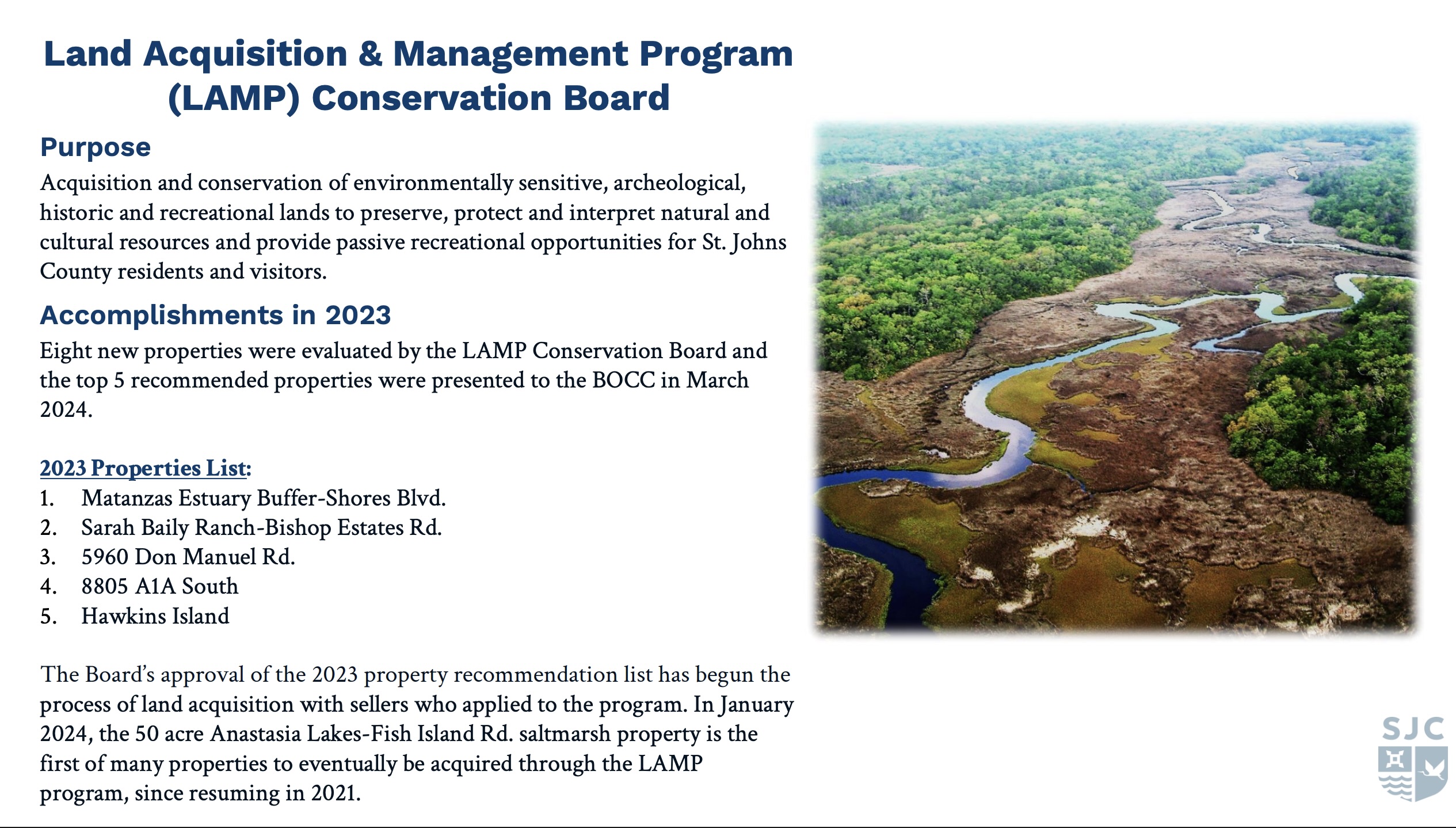
Late 2023: The 195-acre Shores Boulevard property, adjacent to the Moses Creek Conservation Area, was first reviewed by the LAMP Conservation Board.
February 13, 2024: After completing the evaluation process, LAMP scored the property at an average of 82.1 points and ranked it as the County’s highest-priority conservation property.
March 5, 2024: The property was presented to the Board of County Commissioners as LAMP’s top recommendation. The Commission approved the list, allowing County staff to pursue acquisition.
April 2024: LAMP developed a conceptual management plan. The property was discussed as a possible addition to the Moses Creek Conservation Area, potentially managed in partnership with the St. Johns River Water Management District.
March 2025: A full year after BOCC approval, County staff reported that they were still working with the North Florida Land Trust and attempting to assemble funding from multiple sources.
By the next annual recommendation cycle: The property was no longer available for conservation acquisition.
2023 Prioritized Properties List
The loss of this property cannot be attributed solely to inadequate funding, although funding was unquestionably a major obstacle. The timeline also demonstrates how long a conservation acquisition can remain unresolved after the property has been identified as a priority. The property entered LAMP review in late 2023, was ranked first in February 2024 and received BOCC authorization in March. One year later, the County was still attempting to assemble a workable acquisition package. During that time, the owner remained free to consider other opportunities for the property.
Conservation purchases require careful evaluation and responsible use of public money. But willing sellers—particularly owners of valuable, developable property—cannot be expected to wait indefinitely while the County completes annual ranking cycles, secures approvals and searches for funding. In this case, the County identified an exceptional property and ranked it first, but it still could not complete an acquisition before the property became unavailable. Additional funding is necessary, but unless LAMP and the County can evaluate, authorize and negotiate acquisitions more responsively, more important properties may be lost even after voters provide the money.
If voters approve additional financing, the county should also establish a defined route for urgent opportunities: when a special LAMP meeting is warranted, how quickly a recommendation reaches the BOCC, and what preliminary work staff can undertake while preserving public oversight. Faster consideration need not mean less scrutiny.
The program also needs transparent reporting on acquisitions, debt, unspent balances, outside funding and management costs. Buying land creates an ongoing stewardship responsibility. Conservation easements can shift some responsibilities to private owners, but still require attention to monitoring and enforcement.
Residents should not have to choose between an oversimplified promise that this is “only a $100 million bond” and an alarming projection presented as an inevitable outcome. They deserve a clear account of the borrowing limit, the tax rate, permitted uses, duration and oversight.
I believe additional conservation funding is needed. Supporting that need does not require overlooking weaknesses in the acquisition process or minimizing the financial commitment. The ballot decision belongs to the voters. Our responsibility is to make sure they understand it.
If you are finding value in these updates, please subscribe to my blog so you get notifications when I publish an update. Feel free to share with others who may find value in the content.
North Palm Valley Agricultural Enclave: No Approval, No Denial—and the Clock Is Still Running
With 13 items on Tuesday’s agenda, it was going to be a long meeting regardless. But the continued hearing on the North Palm Valley Road Agricultural Enclave certification became the dominant—and most procedurally confusing—discussion of the day.
I’ll keep this post focused on the Agricultural Enclave. Watch for my next post addressing the proposed conservation property-tax levy scheduled for the November 3 ballot.
The North Palm Valley application remained Agenda Item 3 but was moved forward to be heard second, at Commissioner Krista Joseph’s request, because so many residents had come to speak, including some who had taken time away from work.
Even before the item was heard, however, the public comment process became confusing. Commission Chair Clay Murphy allowed residents to address the Agricultural Enclave during general public comment, even though the application remained on the regular agenda for a continued public hearing. The Board’s published rules describe general public comment as the opportunity to address matters not scheduled on the regular agenda.
Some residents spoke then. Others believed they would be able to speak after the applicant’s presentation when the formal hearing resumed. That created understandable confusion over whether public comment on the application had already occurred and whether residents who waited for the agenda item would still be heard.
Several recurring themes emerged during public comment, many of them echoing legal and factual arguments that had circulated on social media before the meeting.
Themes in Public Comment on Ag Enclaves:
Most speakers addressing Senate Bill 686 and the North Palm Valley Road certification raised similar concerns, including:
Whether the applicant could use a metes-and-bounds description to carve approximately 4,462 acres out of larger tax parcels containing more acreage;
Whether the statutory January 1, 2025 eligibility date had been satisfied;
Whether at least 50 percent of the property’s perimeter was surrounded by qualifying development;
Whether vacant but platted lots should count as “developed” property;
Whether the land had been continuously used for bona fide agricultural or silvicultural purposes;
Potential impacts on groundwater, water pressure and future water supply;
Environmental impacts, including wetlands, wildlife habitat, drainage and flooding;
Transportation, school and public-service demands;
The potential financial burden on existing residents for infrastructure required by future development;
The loss of local government authority under the new state law; and
Whether the County should deny the application and defend that decision in court rather than initiate a separate challenge to the statute.
One speaker supported a more pragmatic approach to eventual development and cautioned against treating “no development” as the only acceptable outcome.
Item 3: North Palm Valley Road Agricultural Enclave certification
The approximately 4,462-acre application had been continued from August 19 so staff could review the northern boundary for compliance with Sections 163.3162 and 163.3164, Florida Statutes. County staff and the applicant characterized the northern-boundary question as the limited purpose of the continued hearing. Several residents and commissioners nevertheless raised broader questions about whether the application satisfied the statute.
The applicant’s land use attorney made that point clear and reminded Commissioners that if public comment after the applicant’s presentation on the boundary analysis strayed into other topics, that would give the applicant leeway to bring rebuttal to those comments.
Growth Management Director Mike Roberson reported that the County surveyor had reexamined the legal description. Staff found that the metes-and-bounds description closed properly and constituted an accurate legal description of the property.
The applicant’s attorney, Ellen Avery-Smith, presented that:
Florida law defines a parcel as land capable of being described with sufficient definiteness to establish its location and boundaries;
The owner may designate the portion of the land to be used or developed as a unit;
Fifth District Court of Appeal precedent permits the owner to define a parcel through a metes-and-bounds legal description;
The application therefore could include approximately 4,462 acres without including the entirety of every underlying property identification number; and
The situation differed from the Orange County example Ag Enclave application, cited by some residents in Public Comment. In the example application, the applicant relied on tax parcel numbers and a map but did not provide a separate metes-and-bounds description.
Arguments Presented During the Continued Hearing
During the continued hearing, residents challenging the application focused more specifically on the boundary analysis and the evidence supporting the statutory criteria. They argued that:
The boundaries may have been drawn specifically to remain below the statutory 4,480-acre ceiling;
Portions of existing tax parcels could not necessarily be treated as independent qualifying parcels as of January 1, 2025;
The applicant had not adequately demonstrated that at least 50 percent of the perimeter was surrounded by qualifying urban development;
Vacant platted lots, seawalls and subdivision plats should not automatically be treated as qualifying development;
The historical agricultural or silvicultural use of the property had not been adequately documented;
The Board should require parcel-by-parcel evidence supporting the perimeter calculation; and
The broader environmental, water and infrastructure consequences justified denial or, at minimum, additional independent review.
One specific point of dispute was whether intentionally vacant land within approved developments to the south should be considered “developed.” The applicant responded that platting is itself included within Florida’s statutory definition of development and provided subdivision plats, property records and other materials intended to substantiate the perimeter calculation.
Commissioners’ discussion
Commissioner Whitehurst said County staff had repeatedly concluded that the application met the statute, even after the Board requested additional scrutiny. He distinguished the certification proceeding from an ordinary rezoning, where the Board has broader discretion, and said the Board’s responsibility was to apply the limited criteria established by state law.
Chairman Murphy also said he believed the applicant had demonstrated compliance and that the law itself—not an individual application that appeared to meet its requirements—should be challenged. However, when the approval motion was made, Murphy joined Commissioners Joseph and Taylor in voting against it. Murphy had also voted against denial. With the chairman opposing both possible dispositions, neither motion received the three votes needed for Board action.
Commissioners Taylor and Joseph maintained that both the statute and the supporting evidence remained subject to interpretation. They favored denying the application and allowing a court to determine whether the applicant had established the required acreage, boundaries and surrounding development.
Motions and outcome
The Board took three consequential votes, which caused quite a bit of confusion.
Motion to deny the certification: Failed 3–2. (Commissioners Whitehurst, Arnold and Murphy voting no)
Motion to retain outside counsel and pursue legal action against Senate Bill 686, potentially including injunctive relief: Passed 3–2. (Commissioners Whitehurst and Arnold voting no.)
County counsel cautioned that outside attorneys viewed an affirmative County challenge as an uphill fight, particularly regarding standing, and had previously suggested that the County would be in a stronger position defending a local denial.
Motion to approve the Agricultural Enclave certification: Failed 3–2. (Commissioners Joseph, Taylor and Murphy voting no.)
The Board therefore ended the September 1 meeting in an unusual position. A majority opposed denying the application, but a different majority also opposed approving it.
The property was not certified by the Board on September 1, but the application was not denied. Under the statute, if the County does not formally approve or deny the request within 90 days of receiving it, the property must be certified as an Agricultural Enclave.
At the September 3 budget hearing, Commissioner Joseph requested that the North Palm Valley application be placed on the Board’s September 15 agenda. If placed on that agenda, the application will return to the Commission before the statutory deadline, giving the Board another opportunity to take formal action.
The September 1 votes did not resolve the application, but they revealed the divisions that will follow it into the next hearing. Commissioners Joseph and Taylor supported denial. Commissioners Arnold and Whitehurst supported approval. Chairman Murphy voted against both motions while supporting a separate legal challenge to Senate Bill 686.
The central question for September 15 will be whether one of those positions changes—or whether the Board again fails to reach the three votes required for either approval or denial.
If you are finding value in these updates, please subscribe to my blog so you get notifications when I publish an update. Feel free to share with others who may find value in the content.
What really happened at the Ag Enclave Certification Meeting on Wednesday, August 19.
Spoiler: Thousands of homes were NOT approved
At its August 19 meeting, the St. Johns County Board of County Commissioners considered three applications for agricultural-enclave certification: Heritage Development East, Heritage Development West and N. Palm Valley Road.
The nearly four-hour hearing revealed substantial confusion about what certification does—and does not—approve.
What is most important was the clarification from Deputy County Attorney Kealey West about the Board’s task on Wednesday. It was a very narrow, quasi-judicial lane. Did each application meet the criteria established in SB 686 for an agricultural enclave? It was not a policy vote on whether the Commissioners liked the potential development. The commissioners had to base their decisions on the statutory criteria and the competent, substantial evidence in the record—including the application materials, staff’s review and evidence presented during the hearing.
Statutory maximum discussed as 13 units per acre; no development plan presented
Certified 3–2
Heritage Development West
Approximately 551 acres
Statutory maximum discussed as 13 units per acre; no development plan presented
Certified 3–2
N. Palm Valley Road
Approximately 4,462 acres
Applicant requested 1 unit per acre
Continued to September 1
The two Heritage certifications passed 3-2, with Commissioners Joseph and Taylor voting no.
A motion to deny N. Palm Valley failed 2–3 with Commissioners Whitehurst, Murphy, and Arnold voting against denial.
Before a motion to approve was made, Chairman Murphy requested a continuance to allow staff to reexamine the boundary calculations, particularly the northern boundary. The continuance passed, 4–1 with Arnold being the no vote.
The applicant argued that the two parcels met every statutory criterion:
Approximately 615 acres, within unincorporated St. Johns County.
Owned or controlled by one entity.
Undeveloped as of January 1, 2025.
Used for timber production and classified as agricultural for at least ten years.
Surrounded by qualifying future land-use designations along more than the required percentage of the perimeter.
Within the County’s development area boundary.
Under the statutory acreage cap.
Located in a county with fewer than 1.75 million residents.
The applicant agreed to enter into a binding agreement to provide or pay for required public services.
The applicant said the certification could permit densities up to 13 units per acre based on surrounding land uses. However, counsel acknowledged that 13 single-family homes per acre was probably not a realistic product and said the actual density and development layout would not be known until a development plan was submitted.
Note the important statement there – until a development plan was submitted. A development plan must still be submitted even though the property was certified as an agricultural enclave.
Staff concluded that the application satisfied the agricultural-enclave definition.
Questions from commissioners
Commissioner Whitehurst focused on the distinction between the statutory maximum and actual development. He asked whether a single-family product could realistically achieve 13 units per acre. The applicant said he was unaware of such a product and that setbacks, wetlands and other land-development regulations would affect the final yield.
Commissioner Joseph questioned whether the property had previously been denied, what activity had occurred on the timber property during the previous five years, and whether people, trucks and logging operations were regularly present. The applicant could identify it as a timber operation but could not provide the date of the last harvest or replanting from the podium.
The statute requires the property to have been in continuous bona fide agricultural use for at least five years before the application. The applicant submitted historical aerial imagery showing continued timber use, and County staff independently verified that the property had received an agricultural classification and assessment from 2015 through 2025. Staff concluded that the application demonstrated compliance with the agricultural-use requirement.
Public comment
I normally do not include public comment in my reports. I’m sharing here the highlights because it is important to understand where there is confusion about the certification hearing and what comes next in the process.
Public comment focused primarily on infrastructure, maximum potential density, wetlands and the argument that the County Comprehensive Plan remained controlling. A second line of argument questioned whether agricultural classification and tax-parcel boundaries were sufficient evidence under the statute.
Applicant rebuttal and legal clarification
County Attorney West directly rejected the central Comprehensive Plan argument. She explained that the new law begins with “notwithstanding any other law” and creates a limited statutory preemption. For certification, the Board had to apply the agricultural-enclave criteria rather than the County Comprehensive Plan.
Wetlands, environmental permitting, setbacks and other development regulations would still apply.
A future development plan would still be reviewed by County staff.
Public-services agreements were specifically allowed by the statute.
No public speaker had produced competent evidence contradicting the application’s acreage, ownership, perimeter calculations or agricultural classification.
Board discussion and vote
Commissioner Taylor moved to deny, citing unanswered questions about bona fide agricultural use. Commissioner Joseph seconded.
Commissioner Whitehurst asked what competent evidence had been presented showing that the property was not a bona fide timber operation. He noted that timber production does not require daily activity and questioned whether the proposed denial could be legally defended.
Commissioners Taylor and Joseph voted to deny despite staff findings of compliance and did not identify contrary evidence sufficient to persuade the majority.
The denial failed 2–3. A subsequent motion to certify passed 3–2.
The second Heritage presentation was largely parallel to the first because it involved the same owner and statutory framework.
The applicant represented that:
The application covered three parcels totaling approximately 551 acres.
The parcels were undeveloped and under single ownership or control.
The land had been used for timber production and classified as agricultural.
More than 75% of the perimeter qualified under the applicable surrounding-development test.
The applicant offered to enter into agreements for required public services.
The property met the acreage and county-population limits.
County staff found that the application met the statutory definition.
As with Heritage East, the presentation discussed a maximum potential density of 13 units per acre calculated from surrounding land uses under the statute, but no development plan or actual unit count was presented.
Public comment
Public comment expanded during the West hearing.
Similar arguments were repeated during the Heritage West hearing, despite County counsel’s earlier explanation that SB 686 creates a limited preemption for the certification decision. Other comments addressed schools, agricultural documentation, parcel boundaries, traffic, wetlands and wildlife.
The agricultural-use evidence was substantially the same as for Heritage East: historical aerial imagery, a reported timber operation dating to 1956, and agricultural classification and assessment from 2015 through 2025. County staff independently reviewed the records and found that the application satisfied the statutory requirement.
Applicant rebuttal and staff response
The applicant emphasized that the property appraiser classifies agricultural and nonagricultural land annually under Section 193.461. Therefore, the classification was not a one-time designation from many years earlier.
Counsel also explained that:
The statutory definition of “parcel of land” does not prohibit using a property-appraiser parcel.
Agricultural classification was supported by the property appraiser’s annual review.
The offer to provide or pay for required services was the alternative expressly authorized by the statute.
County staff confirmed that it had consulted with Property Appraiser Eddie Creamer and his staff, reviewed their agricultural-classification methodology, and was comfortable with the determinations.
Board discussion and vote
Chairman Murphy gave one of the clearest summaries of the Board’s dilemma. He said St. Johns County was suffering from growth fatigue and that he disliked the state preemption, but his personal view of growth was not the legal standard. He said he could not identify a legally supportable reason to deny an application that staff concluded met the law.
Commissioners Taylor and Joseph again voted to deny despite staff findings of compliance and did not identify contrary evidence sufficient to persuade the majority.
Heritage West was certified 3–2.
3. N. Palm Valley Road
This hearing was substantially longer and produced more focused statutory challenges than the Heritage hearings.
The applicant emphasized that the application contained more than 500 pages of supporting material, including:
A signed and sealed legal description and survey.
Deeds and ownership records.
Property-appraiser records.
A timber-management plan.
Timber-sales information.
Sworn affidavits.
Perimeter and surrounding-development calculations.
Letters concerning utilities, schools and other public services.
The applicant repeatedly corrected the claim that it was seeking six units per acre:
The request was one single-family residential unit per acre—approximately 4,462 units—not 26,772 units.
County staff had calculated that the statute could support a maximum of six units per acre based on surrounding land uses, but that was not what the applicant requested. Later in the hearing, County staff said the one-unit-per-acre commitment would be incorporated into a future development agreement, and applicant’s counsel stated on the record that there would be no more than 4,462 units.
The applicant argued that the property met the applicable 75%/50% perimeter test:
Approximately 84% of its perimeter was adjacent to qualifying residential, commercial or industrial designations.
Approximately 50.88% qualified as existing development.
The calculations were based on a signed and sealed survey.
Land across the Intracoastal Waterway, in Nocatee and in Duval County was used in the analysis.
The statute expressly requires looking across rights-of-way, bodies of water and canals.
Nothing in the statute prohibits considering land in an adjacent jurisdiction.
The applicant also explained that certification did not eliminate:
Wetlands and environmental permitting.
Transportation analysis.
School concurrency.
Proportionate-share requirements.
Utility permitting.
Construction-plan review.
County land-development regulations.
Commissioner questions before public comment
Commissioner Joseph questioned:
The Davis family’s ownership of adjoining land in Duval County.
Why the owner did not proceed through the ordinary public development process.
Whether the one-unit-per-acre commitment could later be increased.
Where traffic would go.
Whether an independent forester should inspect the property.
When timber had last been planted or harvested.
The applicant responded that the property had a timber-management plan, timber-sales information, a full-time property manager and agricultural records. Counsel declined to agree that an additional inspection was necessary.
Commissioner Taylor asked how the one-unit-per-acre representation could be guaranteed. Staff responded that the statute establishes potential density from surrounding land, but the applicant’s one-unit commitment would be written into the future development agreement.
Chairman Murphy asked whether the owner could later use this certification to qualify adjoining land to the north. Counsel cited language prohibiting an applicant from using the perimeter of one certified enclave to qualify another.
Public comment: the stronger statutory challenges
Some of the N. Palm Valley comments were much more closely connected to the actual certification criteria than comments made during the Heritage hearings.
Whether the 50% test should measure the percentage of the surrounding parcels that is developed rather than the percentage of the enclave perimeter touching development.
Whether the qualifying acreage existed as a legally defined configuration as of January 1, 2025.
Whether the application relied on a boundary drawn in 2026 rather than the parcels existing in 2025.
Whether the approximately 50.88% result depended on an impermissible calculation.
Whether the one-unit-per-acre representation was legally binding.
The meaning of “the local government” in the statute.
Whether the 50% test was being applied to perimeter length rather than the area or condition of the surrounding parcels.
Whether the Board should continue the hearing to obtain a written legal analysis.
Whether land in another county could be considered at all. This was an interesting statutory question, although the applicant argued that the law requires examination of surrounding lands and contains no same-county restriction.
Those were the portions of public comment most directly relevant to the Board’s certification decision.
Public comment: development-impact arguments
A large portion of the remaining public comment concerned:
Traffic on Palm Valley Road, Roscoe Boulevard, A1A and Nocatee Parkway.
School construction and taxpayer debt.
Water pressure and potable-water supply.
Wetlands, wildlife, tree removal and climate impacts.
The lack of a transportation plan.
Residents’ loss of public input over the eventual development plan.
General opposition to rapid growth.
Requests that the Board “fight” the statute in court.
These are legitimate development concerns. However, they generally did not rebut the applicant’s evidence on the statutory certification criteria. The development plan for the property is not part of the certification process.
Several speakers explicitly acknowledged that they did not understand the legal process or were not attempting to make a statutory argument. Their comments were largely appeals to deny or delay development based on its anticipated impacts.
Applicant rebuttal
The applicant responded point by point:
The application boundary was supported by a signed and sealed legal description and survey.
The alternative map displayed by a public speaker was not the map in the application.
The statutory definition permits an owner or developer to designate a describable parcel of land.
The long parcel along the Intracoastal was included in the timber-management plan and sworn agricultural-use testimony.
The 50.88% calculation came from surveyed boundary dimensions.
“Development” under Chapter 380 can include subdivision of land, shoreline alteration and other improvements; a parcel need not contain a completed house to constitute existing development.
The statute does not prohibit considering adjoining land in Duval County.
JEA had provided a letter stating that it could serve the property.
The project would still undergo concurrency and development-plan review.
The applicant committed on the record to no more than 4,462 units.
The applicant submitted a Property Appraiser letter, property records, aerial imagery, a timber-management plan, timber-sales information and sworn testimony concerning the property’s agricultural use. Staff reviewed the documentation and independently concluded that the property had been in continuous bona fide agricultural use for the required five-year period.
Board discussion and continuance
Commissioner Taylor moved to deny based on insufficient proof of agricultural use and inadequate infrastructure under the Community Planning Act. Commissioner Joseph seconded. The motion failed 2–3 with Commissioners Whitehurst, Murphy and Arnold voting against denial.
Before an approval motion was made, Chairman Murphy asked for a continuance. He said public comment had raised questions about the boundary calculations that he wanted staff to examine more fully.
The Board voted 4-1 to continue the hearing until September 1 and directed staff to recheck the boundary, particularly in the northern portion, using GIS. Commissioner Joseph also requested an independent forestry review and renewed Community Planning Act analysis, but the Board did not reach consensus on those requests.
Commissioner Whitehurst cautioned against imposing a more demanding evidentiary standard on N. Palm Valley than the Board had applied to the two Heritage applications.
What the hearing clarified—and what it did not approve
The most persistent confusion throughout the hearing was the belief that certification approved thousands of homes for immediate development.
It did not.
No development plan was before the Board for any of the three applications. Certification determines whether property meets the definition of an agricultural enclave established by state law. It does not eliminate the later requirements for environmental permitting, concurrency, transportation analysis, utility review, construction plans or compliance with applicable land-development regulations.
Maximum density is not a development plan
The Heritage properties were discussed using a statutory maximum of 13 units per acre. Those maximums were repeatedly converted into claims that approximately 8,000 homes had been approved on Heritage East and 7,000 on Heritage West.
No such development plans were presented or approved.
The applicant acknowledged that it was not aware of a single-family housing product that could realistically achieve 13 units per acre. Wetlands, setbacks, infrastructure requirements and other development regulations will affect the ultimate number and location of homes.
The same confusion surrounded N. Palm Valley. The statute could support a maximum of six units per acre based on surrounding land uses, but the applicant requested one unit per acre from the beginning—approximately 4,462 units, not 26,772. During the hearing, the applicant committed on the record to that limit, and County staff stated that it would be incorporated into the development agreement.
Infrastructure concerns did not automatically defeat certification
Many comments focused on roads, schools, utilities and other infrastructure. Those concerns will matter as development plans are prepared and reviewed, but existing infrastructure deficiencies were not an automatic basis for denying certification.
SB 686 expressly allows an applicant either to demonstrate that required public services exist or to agree to provide, fund, construct or dedicate land for those services.
The argument that the County Comprehensive Plan nevertheless allowed commissioners to deny certification was also addressed directly by County Attorney Kealey West. She explained that SB 686 creates a limited preemption for the certification process. The Board was required to apply the agricultural-enclave criteria established by state law—not the County’s ordinary discretionary standards for a Comprehensive Plan amendment.
Questions are not evidence of noncompliance
Commissioners Taylor and Joseph questioned whether the properties had been in bona fide agricultural use and supported motions to deny. However, County staff had reviewed the applications, consulted with the Property Appraiser’s Office and found that the agricultural-use requirements were satisfied.
Commissioner Whitehurst repeatedly asked what competent, substantial evidence had been introduced to contradict those findings. Questions about when timber was last harvested, whether workers were present every day or whether additional inspections might provide greater comfort did not, by themselves, establish that the statutory requirement had not been met.
The majority ultimately concluded that the Heritage applicants had demonstrated compliance and that the record did not support denial.
Why N. Palm Valley was continued
N. Palm Valley produced a different result because some questions were tied more directly to the statutory certification test.
Those questions concerned the application boundary and the calculations used to determine whether the property met the required surrounding-development percentages. Chairman Murphy requested additional time for staff to recheck the boundary, particularly along the northern portion of the property.
The hearing was continued to September 1. The application was neither approved nor denied.
The real divide at the hearing
The commissioners were not deciding whether additional growth was good for St. Johns County. They were deciding whether each property met a definition created by the Florida Legislature.
That distinction was uncomfortable but controlling.
Commissioners could dislike the law, oppose state preemption and share residents’ concerns about infrastructure. What they could not responsibly do in a quasi-judicial hearing was deny an application solely because they opposed the development that might eventually follow.
Heritage East and Heritage West were certified because the majority concluded that the applications met the statutory requirements. N. Palm Valley was continued because the majority wanted one certification issue—the boundary calculation—examined more closely.
Thousands of homes were not approved on August 19. Two properties were certified as agricultural enclaves, and one certification hearing remains open.
If you are finding value in these updates, please subscribe to my blog so you get notifications when I publish an update. Feel free to share with others who may find value in the content.